
What does Dividend Yield TTM mean ?
In financial contexts and dividend tracking tools, TTM stands for Trailing Twelve Months.
It refers to the data from the most recent 12-month period leading up to the present date.
1. Understanding TTM
While many financial reports are based on the “Fiscal Year,” TTM provides a look at the last 12 consecutive months of performance.
For example, if it is currently April 2026, the TTM data would combine the most recently reported quarterly results to cover the past year, rather than waiting for the next annual report.
2. How Dividend Yield (TTM) is Calculated
The TTM Dividend Yield is calculated using the following formula:
Dividend Yield (TTM) = {Total Dividends Paid per Share over the Last 12 Months}/{Current Share Price}
- Fact-Based: It is based on “Actuals” (what was already paid) rather than projections.
- Example: If a company paid four quarterly dividends of $0.50 each over the past year, the total of $2.00 is divided by the current stock price.
3. TTM vs. Forward Yield
Most dividend trackers display two types of yields: TTM and Forward.
| Metric | Definition | Characteristics |
| Dividend Yield (TTM) | Based on the past 12 months of payments. | Reliable because it uses actual data, but may not reflect recent dividend cuts or raises immediately. |
| Forward Yield | Based on the projected next 12 months. | Calculated by taking the most recent dividend and annualizing it. Reflects current changes instantly. |
4. Key Considerations
Since TTM is based on historical data, it may include “Special Dividends” (one-time payments). This can sometimes make the yield appear unusually high. It is always important to check if the high yield is sustainable or just a result of a one-time payout.
Summary
When evaluating a stock, investors typically compare TTM (the track record) with the Forward Yield (the outlook) to ensure the dividend is stable and growing.
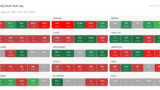
You can check stock heatmap as shown below. It is very useful for cell phone and mobile.